There's a town in Norway where the road signs appear in several languages, the local delicacy has legs longer than some people's arms and Russia is less than ten miles away.
It's called Kirkenes, and geographically speaking, Norway has placed it in a rather surprising position. Tucked into the country's far northeastern corner, well beyond the Arctic Circle, it's closer to the Russian city of Murmansk than to Tromsø, and a very long way from the fjords, waterfalls and picturesque wooden villages that feature in most Norwegian holiday brochures.
Here, the landscape is a mixture of rocky Arctic coastline, sparse woodland and vast stretches of tundra. Winters bring long darkness and thick snow, while summer offers weeks of almost continuous daylight. The town has a complicated history involving iron ore, Soviet soldiers and one of the most heavily bombed communities in Europe during the Second World War.
And despite feeling like somewhere you might need a particularly determined expedition leader to reach, Kirkenes is the northern terminus of Norway's famous coastal shipping route. You can arrive by sea, explore the town and continue south through some of Europe's most spectacular coastal scenery.
Kirkenes: Norway's Arctic town beside the Russian border
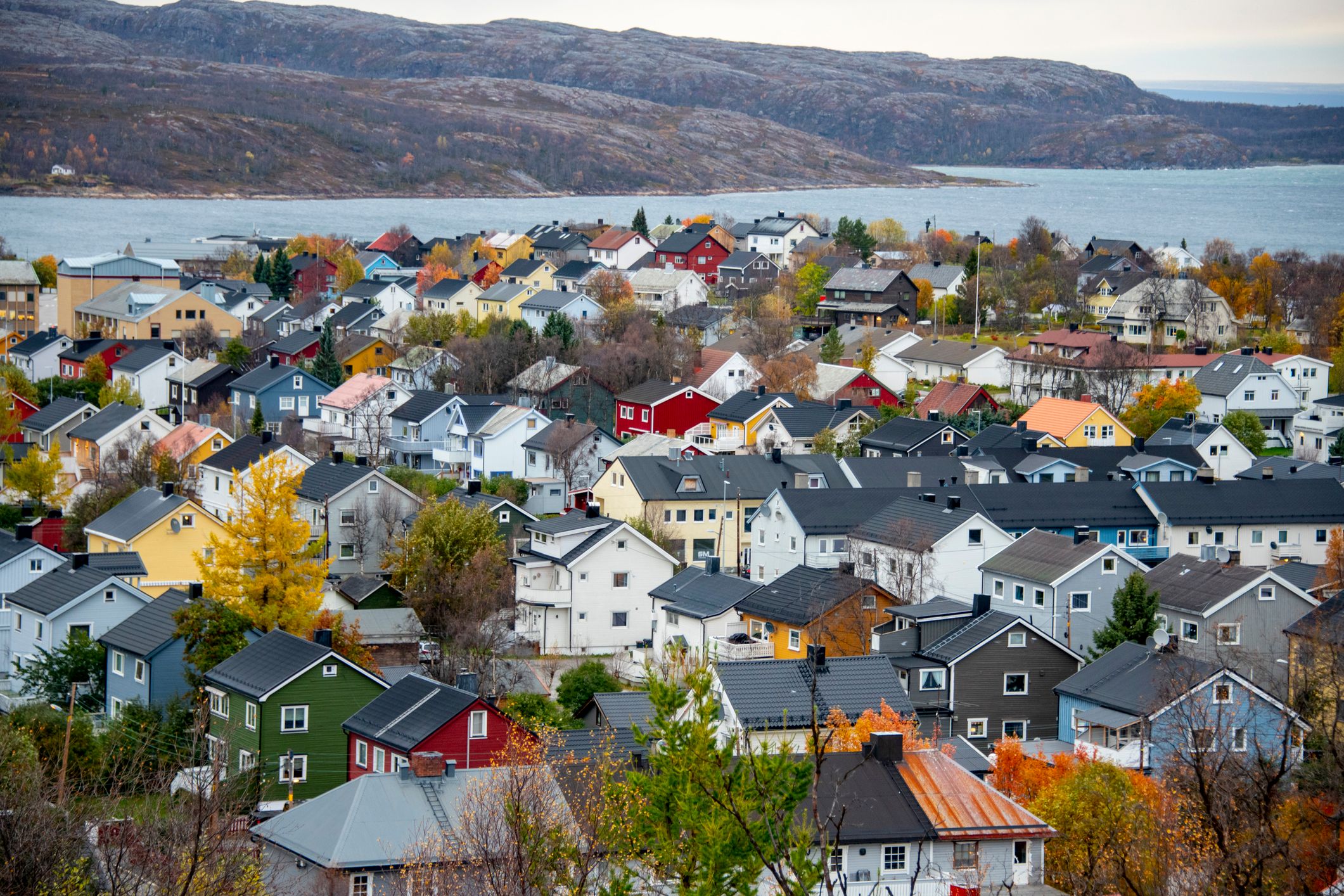
Kirkenes sits on Bøkfjorden, an inlet leading towards the Barents Sea, in Norway's Sør-Varanger municipality. The Russian border lies around 15km to the east, while Finland is within reach to the southwest.
Its position has given the town an identity quite different from much of Norway. Norwegian, Russian, Sámi and Finnish influences have shaped the wider region, and multilingual signs offer a reminder that this is a place where cultures have met for centuries.
Visit Norway describes Kirkenes as a multicultural centre of the Barents region, reflecting the different communities that have lived, worked and traded here.
You won't find the elaborate waterfront architecture of Bergen or the dramatic sheer-sided fjords of western Norway. Kirkenes is a working Arctic town, with fishing boats, practical buildings and a landscape whose beauty can initially seem rather severe.
But there's something compelling about its remoteness. On a clear winter day, the light can turn the snow-covered hills a delicate blue, while the harbour remains busy beneath an enormous sky. In summer, the sun scarcely bothers to set, giving the town the slightly surreal atmosphere of a place where everyone has collectively agreed to ignore bedtime.
And wherever you go, the border is never far away.
What happened to Kirkenes during the Second World War?
To understand Kirkenes, it's worth spending some time with its extraordinary wartime history.
Following Germany's occupation of Norway in 1940, Kirkenes became a major German military base for operations against the Soviet Union. Its strategic position near the Soviet border made it an important target for Allied bombing raids, particularly Soviet aircraft.
The town suffered more than 300 air raids during the war. Much of Kirkenes was destroyed, and residents repeatedly sought shelter underground.
One of the most affecting places to visit today is Andersgrotta, an underground bomb shelter in central Kirkenes. Guided visits take around 30 minutes and include a short film explaining what local people experienced during the attacks.
It's difficult to reconcile the relatively peaceful town above ground with the circumstances that forced families to spend so much time beneath it.
In October 1944, Soviet forces advanced into eastern Finnmark as German troops retreated. Nearly 2,000 civilians sheltered in a mining tunnel at nearby Bjørnevatn, escaping German evacuation efforts. On 25 October, the Red Army liberated Sør-Varanger, the first part of Norway to be freed from German occupation. Soviet troops remained in the region until autumn 1945.
That history gives Kirkenes a complicated relationship with its eastern neighbour. The Soviet liberation is remembered with gratitude, even as present-day relations between Norway and Russia are shaped by a very different political reality.
For a deeper understanding, visit the Borderland Museum, known locally as Grenselandmuseet. Its exhibitions explore wartime experiences, the iron-mining industry and the cultures of this border region. The adjoining Savio Museum also displays work connected to Sámi artist John Savio.
It's an excellent place to begin if you want to understand why Kirkenes feels so distinct from the rest of the country.
Can you visit the Russian border from Kirkenes?

The proximity to Russia is undeniably intriguing, and several local sightseeing excursions include visits to viewpoints or permitted areas near the frontier.
The border itself is tightly controlled, however. Norway and Russia share a 197.7km land and river boundary, and the Norwegian police warn visitors to maintain a safe distance from the border and respect all markings and restrictions. Crossing is permitted only at the official Storskog checkpoint.
This is particularly important because the border runs through forests and waterways where its precise position may not always be obvious.
It's also worth understanding how relations have changed. Since Russia's full-scale invasion of Ukraine in 2022, Norway has tightened its entry restrictions for Russian nationals. From May 2024, Russian citizens travelling for tourism or other non-essential purposes have generally been refused entry, subject to specified exceptions.
That doesn't mean visitors to Kirkenes can't approach authorised viewpoints on the Norwegian side. But a casual excursion across the border isn't something to build into your holiday plans.
For cruise passengers, an organised local tour offers a far more sensible introduction to the border region, with a guide who understands where visitors are permitted to go and how the area's history continues to influence everyday life.
The border is interesting enough from Norway. There's little reason to create an international incident in pursuit of a photograph.
King crab safaris in Kirkenes: an Arctic adventure with enormous claws

If the border provides Kirkenes with its geopolitical intrigue, the local king crabs supply its more improbable wildlife encounters.
These enormous crustaceans can have leg spans approaching two metres and are now an established part of the eastern Finnmark fishing industry. Red king crabs were introduced into the Barents Sea by Soviet scientists during the twentieth century, spreading westwards into Norwegian waters.
Their arrival has been ecologically controversial, with concerns about the effects of a large introduced predator on seabed habitats. But the species has also created a valuable commercial fishery and one of Kirkenes's most distinctive visitor experiences.
On a king crab safari, participants travel onto the fjord with a local guide, watch or help retrieve crab pots and learn about the fishing industry before enjoying a freshly prepared meal.
Snow Resort Kirkenes offers excursions during different seasons, using rigid inflatable boats during warmer months and alternative arrangements when winter conditions take over. Its summer experience includes warm clothing, safety equipment, transport and a meal.
There's something wonderfully extravagant about travelling to the edge of Europe to meet an animal that looks like an oversized piece of specialist plumbing equipment, particularly when the encounter concludes with lunch.
The tours aren't cheap, though, and some take several hours. Passengers visiting on a short coastal-service stop should book an excursion specifically timed to their ship, rather than assuming a standard afternoon departure will work.
Snow hotels, northern lights and the Arctic wilderness

Kirkenes's other great attraction is the landscape surrounding it.
In winter, visitors can try dog sledding, snowshoeing and snowmobile excursions, while the long Arctic nights provide opportunities to see the northern lights when skies are clear and solar activity cooperates.
The region's snow accommodation is another draw. Snow Resort Kirkenes offers rooms decorated with ice and snow sculptures, alongside warmer accommodation for travellers who prefer their bedrooms at a temperature more normally associated with human habitation.
Activities vary by season, and some require advance booking or transfers from the town.

Farther inland, the Pasvik Valley extends towards the Finnish and Russian borders. Its forests, lakes and wetlands feel remarkably different from the exposed coastal landscape around Kirkenes. The wider region is also associated with brown bears and a distinctive range of Arctic and boreal wildlife, although sightings are never guaranteed.
Exploring Pasvik properly deserves more than a rushed port call. It's an excellent reason to spend an extra day or two in Kirkenes before embarking on a coastal voyage.
Summer brings a completely different experience. The midnight sun replaces the northern lights, while hiking, birdwatching and boat excursions make better use of the long daylight hours.
And you needn't feel particularly guilty about staying out late. For several weeks, the sun is doing exactly the same thing.
How to visit Kirkenes on a Norwegian coastal cruise

Kirkenes marks the turning point of Norway's traditional coastal route, operated by Hurtigruten and Havila Voyages.
The route connects Bergen with communities along Norway's coast, calling at fishing villages, Arctic towns and major ports including Trondheim, Bodø, Tromsø and Hammerfest.
Unlike a conventional cruise focused entirely on leisure, the coastal service also transports passengers and goods between communities. That gives it a different rhythm, with some stops lasting several hours and others barely long enough to admire the harbour before the ship departs again.
Both operators' published schedules show ships arriving in Kirkenes at around 9am and departing southbound at 12.30pm. That's only three and a half hours in port, including the time needed to disembark and return to the ship.
It's enough to experience something of Kirkenes, but careful planning is essential.
If you're continuing south on the same ship, a prebooked excursion designed around the coastal timetable is the safest option. A guided visit to Andersgrotta or a short historical tour could work well; the Borderland Museum is another possibility if transport and opening hours align.
Longer excursions into the Pasvik Valley, comprehensive king crab experiences and more ambitious Arctic adventures are better suited to passengers beginning or ending their voyage here.
And that may be the smartest way to discover Kirkenes. Rather than treating it as a brief turnaround port, spend a night or two exploring the town before sailing south towards Tromsø and the Lofoten Islands.
Kirkenes has its own airport, Høybuktmoen, with transport connections to the town and harbour. Havila estimates the airport-to-terminal journey at around 15 to 20 minutes by taxi, although passengers should allow considerably more time around flight arrivals and ship departures.
Is Kirkenes worth visiting on a cruise?

That depends on what draws you to Norway in the first place.
If you're dreaming of towering fjords, colourful fishing villages and waterfalls plunging from impossible heights, western Norway offers more immediately spectacular scenery.
Kirkenes asks for a different kind of curiosity.
Its appeal lies in the unusual combination of Arctic wilderness, borderland cultures and history. Here, the story of Norway becomes inseparable from that of its neighbours, from Sámi communities and cross-border trade to the Second World War and the complicated politics of the present day.
There are also enormous crabs, which is admittedly a less intellectually demanding reason to visit, but a perfectly respectable one.
And arriving by sea feels particularly appropriate. For generations, Norway's coastal ships have connected distant settlements with the rest of the country, making journeys that would otherwise involve formidable distances overland.
Today, that same route allows travellers to reach one of Europe's most remote corners without organising an expedition across the Arctic.
Kirkenes might not resemble the Norway on the postcards. But that's a large part of what makes it worth the journey.