There is a special kind of smug that comes from standing on deck, pointing at a cluster of dots and saying “that one is Orion” instead of “that one is… shiny”. The good news is you do not need to remember what refraction is, or have passed GCSE physics, to get there. A cruise is one of the easiest places to start.
Most of the time, ships spend their nights gliding through relatively dark water, well away from city glare. That means less light pollution, clearer horizons and a sky that looks a lot busier than the one above your local supermarket car park. Add the fact that more lines are focusing on astronomy with experts, themed sailings and the occasional planetarium, and suddenly the top deck after dinner looks a lot more interesting.
This is your simple, non-intimidating guide to using it.
Why cruise ships make decent observatories
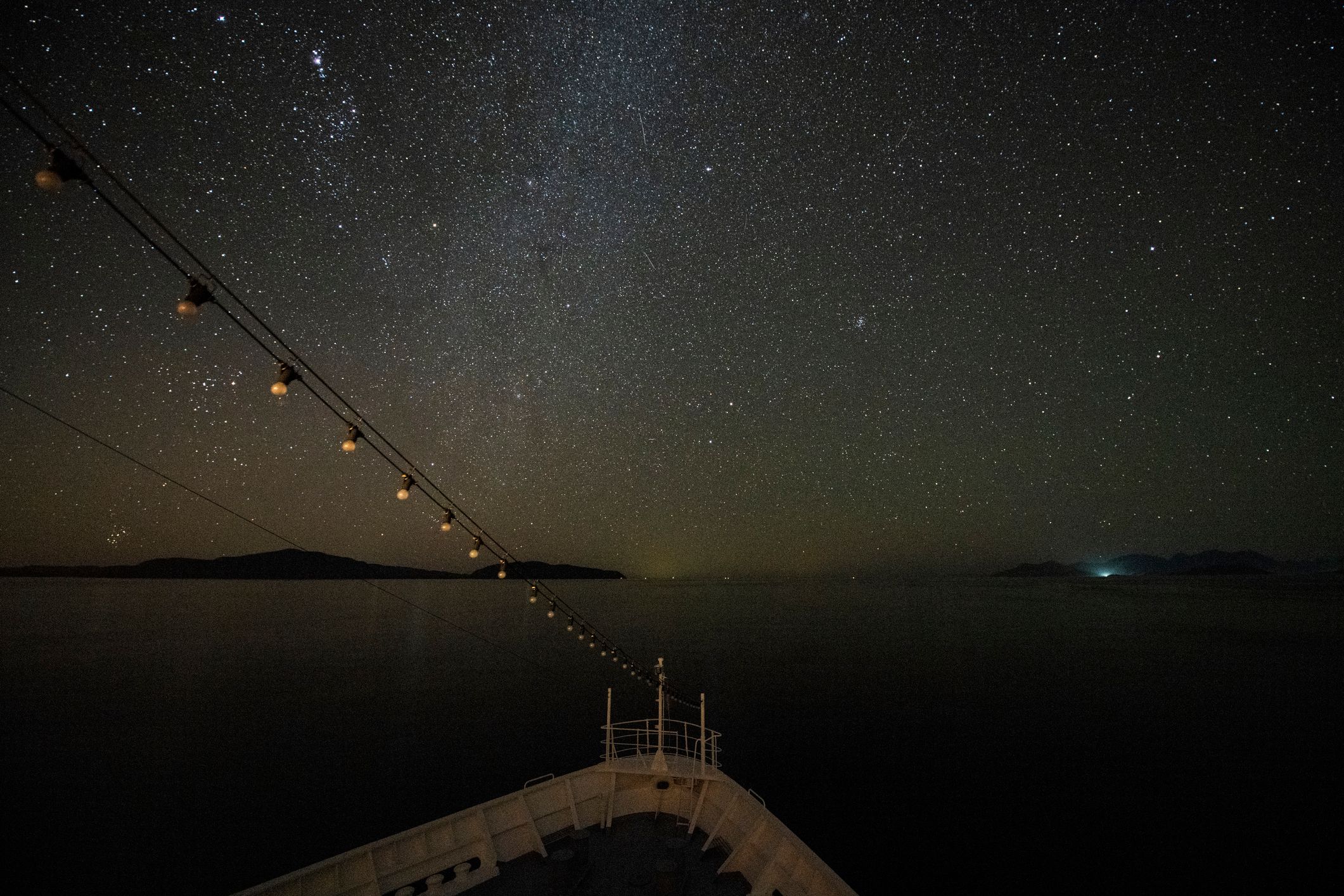
Astronomers like remote deserts and mountaintops. The rest of us are more partial to a bar stool and a jacket that is not labelled “technical shell”. Out at sea you get a miniature version of the same conditions: darker skies, wide horizons and less haze from traffic and industry than you would find on land.
The ship itself is your main enemy. Pool decks, LED screens and late-night cocktails all throw light upwards, so the trick is to find the quiet corners. Head for the forward observation deck if it is open, or an upper promenade away from the pool and big outdoor screens. Let your eyes adjust for ten or fifteen minutes, try not to keep checking your phone, and the sky will start to fill in.
If you are in the tropics you get a high, bright band of the Milky Way on clear nights. Further north or south, the sky feels lower and more dramatic, with the constellations sitting closer to the horizon. On Arctic and Antarctic routes there is the added chaos factor of the aurora, which will happily photobomb your attempts to look knowledgeable.
The constellations you can actually find
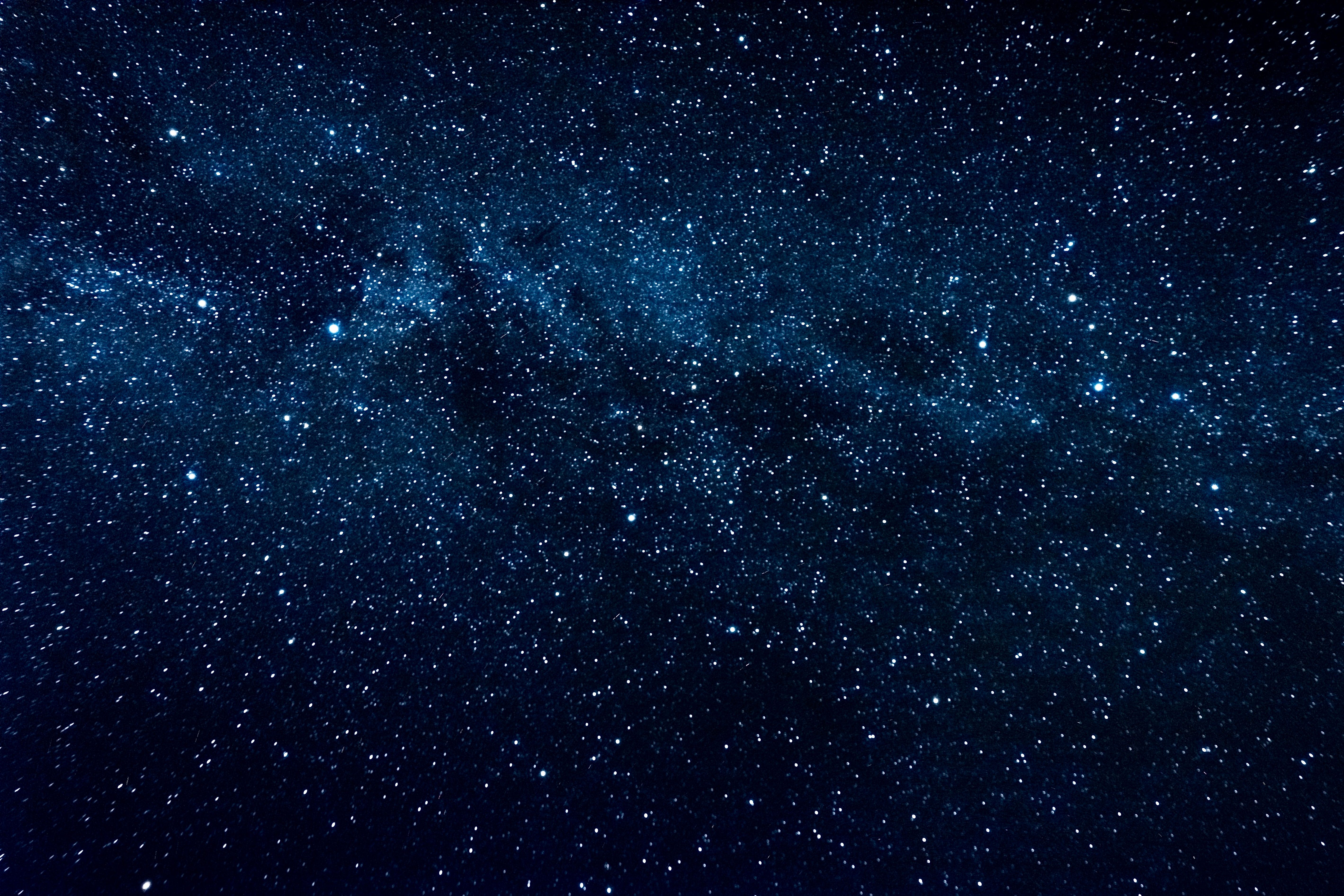
Treat this like learning landmarks in a new city. You do not need to memorise every star, just a few obvious shapes to get your bearings.
In the northern hemisphere, the easiest way in is the Plough (or Big Dipper) – the saucepan shape that appears on every novelty mug. Follow the two stars at the pan end upwards and you hit Polaris, the North Star, which conveniently sits very close to true north. Work along from there and you reach Cassiopeia, the lopsided “W” that looks like it was drawn by a toddler with a ruler.
Orion is the show-off. In winter and spring, look for three bright stars in a row that form his belt, with a faint smudge just below that reveals itself as the Orion Nebula in binoculars. Once you have him, the rest of the sky starts to line up around it.
In the southern hemisphere, ships heading towards Cape Town, Sydney or Buenos Aires open up a different sky. Here the Southern Cross does the job of the Plough, four bright stars in a compact kite shape with a trailing “pointer” pair next to it. It is smaller than you expect and prettier than any flag gives it credit for.
You can absolutely do this with a free stargazing app, but there is a certain joy in leaving your phone in your pocket and using a simple star wheel or ship’s own guide instead. Several lines now hand out constellation maps on astronomy themed nights, which makes the whole thing feel more grown-up than waving your mobile at the sky.
Lines that focus on stargazing

You do not need a specially branded “astro cruise” to enjoy the night sky, but if you like the idea of expert backup, some lines have gone much further than “look, stars”.
Cunard’s Queen Mary 2 has a proper planetarium, Illuminations, where guest astronomers and physicists run live talks and mapped projections, often in partnership with bodies such as the Royal Astronomical Society. It is as close as you will get to lying back in a darkened room at sea and having the universe explained to you without anyone mentioning homework.
Princess Cruises runs a Discovery at Sea programme which includes guided stargazing sessions. On clear nights crew dim parts of the top deck and hand out blankets while a presenter walks guests through constellations and visible planets, using laser pointers to connect the dots.
Viking has gone very all in, particularly on ships such as Viking Orion and its expedition vessels, which carry a Resident Astronomer to host lectures, deck sessions and talks in the shipboard planetarium about everything from navigation by the stars to exoplanets.
Further north, Hurtigruten mixes astronomy and everyday seamanship on certain winter coastal voyages, combining Northern Lights hunting with on deck stargazing led by guest scientists and lecturers.
And if you really want to lean into it, the 12 August 2026 total solar eclipse will pass over Greenland, Iceland and northern Spain. Several lines, from Holland America to Celebrity and Ponant, are lining up dedicated eclipse cruises that place you directly under the path of totality, usually with astronomers and science communicators on board.
For everyone else, even a standard Med or Caribbean itinerary will have at least a few nights far enough from land for decent stargazing. The key is remembering the sky exists once the show finishes.
How strict is this “science” business, really?

On genuine expedition sailings, especially in the polar regions and the Galápagos, expedition staff will absolutely talk about light pollution, atmospheric conditions and why you should not shine torches into the sky. On mainstream itineraries, the tone is much more forgiving.
The unwritten rules are mostly common sense. Keep phone screens dim, avoid flash photography, and do not use a bright white torch near other people’s eyes. Red-light torches are kinder to night vision if you end up getting into this more seriously. Listen to crew instructions about which decks are open after dark, particularly in rougher seas.
Beyond that, it is surprisingly informal. If there is a hosted stargazing session, you can turn up for ten minutes, ask a couple of questions about “that big bright one over there” and wander off again without being made to feel like you are back in double physics.
A tiny bit of kit that actually helps

You can happily go out with just your eyes and a cardigan. But if you want to graduate from “ooh, pretty” to “I can see Saturn’s rings and am now annoyingly pleased with myself”, a few things make a disproportionate difference.
Compact binoculars are the easiest win. On land they are for spotting distant lighthouses and the ship you are about to miss. Pointed upwards, they turn patches of faint fuzz into clusters, reveal moons around Jupiter and pick out texture on the face of the moon. A small notebook is useful if you like the idea of remembering what you saw and when, rather than trying to replay it later via half-lit photos on your phone.
If you are genuinely keen, some lines let you bring a small tripod and camera to shoot the Milky Way on longer exposures. Just bear in mind the ship is always moving, even when it feels still. This is not the place to unravel an entire home observatory.
Where this fits in a normal cruise
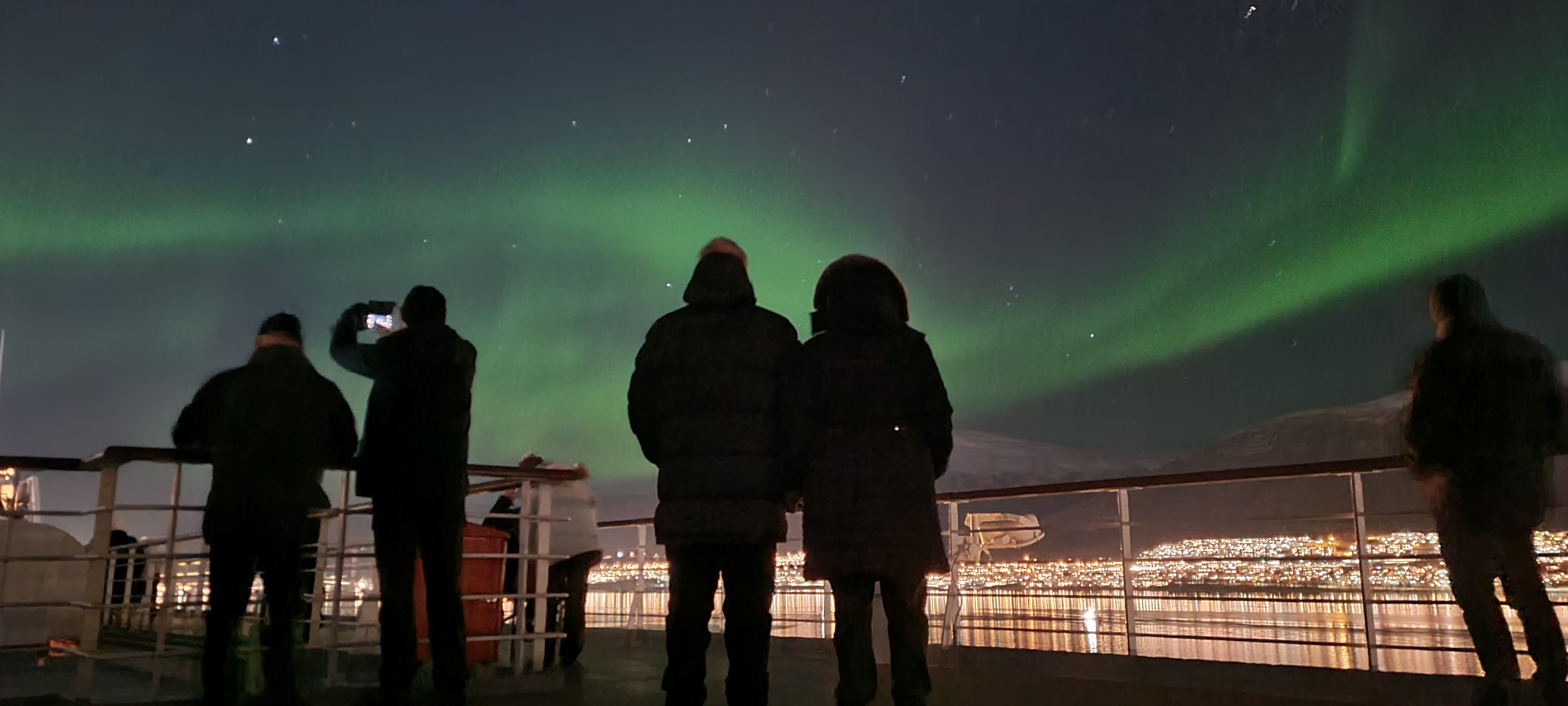
You do not need to turn your holiday into a week-long astronomy camp. Think of stargazing as a small, satisfying extra that fits between dessert and sleep. One night you might spend ten minutes after dinner ticking off Orion over the Atlantic. Another, you may find yourself at midnight on deck with a hot chocolate watching the Pleiades climb higher while the wake glows behind you.
If you happen to be on one of the lines that brings in astronomers or offers themed cruises, treat the lectures and planetarium shows as you would any other onboard entertainment, just with fewer sequins. For everyone else, simply make a deal with yourself to step outside on at least a couple of clear nights and look up properly rather than scrolling.
You will not come home ready to give a TED talk on cosmology. You might, however, find that seeing the sky from the middle of the sea quietly reboots your sense of scale. And the next time someone points at a star and calls it “the North one”, you will be able to gently, smugly, set them straight.